
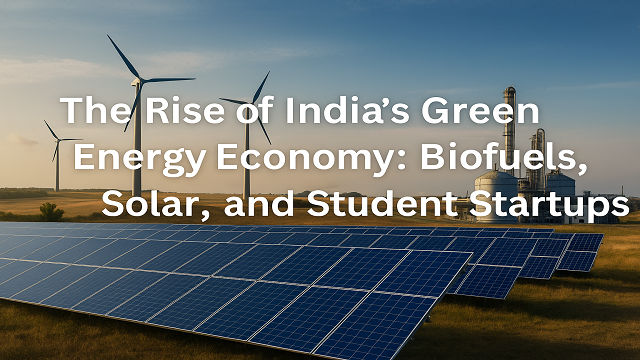
India is entering a transformative phase in its economic journey where growth and sustainability are no longer two separate paths, but part of a shared vision. The recent push toward renewable energy, particularly in biofuels and solar, reflects a shift not only in policy but also in mindset. At the heart of this transition are India’s young students and small businesses who stand to benefit from the opportunities emerging in the green energy economy.
This article takes a closer look at how India is reshaping its future through bio-ethanol projects, solar energy expansion, global green financing, and government support. It also explores how this transformation creates unique possibilities for students preparing for careers and for small businesses seeking to innovate.
Bio-Ethanol and the Assam Example
One of the most remarkable developments in recent months has been the ₹3,500 crore financing deal between the Power Finance Corporation (PFC) and the Japan Bank for International Cooperation (JBIC). The agreement is designed to accelerate India’s renewable energy sector, with a special focus on bio-ethanol projects. Among the flagship ventures is the bio-ethanol plant in Assam, which is expected to change the way India approaches clean fuel.
The significance of bio-ethanol lies in its ability to reduce India’s dependence on imported crude oil. By producing clean fuel locally, India can address two critical challenges at once—energy security and environmental sustainability. Farmers will also gain new income streams by supplying agricultural residues such as rice husk and sugarcane waste to the ethanol industry. This creates a ripple effect where agriculture, industry, and energy converge for mutual benefit.
For students, this development is more than just a policy milestone. It is a potential career path in biotechnology, chemical engineering, and agricultural sciences. Young entrepreneurs can even explore startups that provide solutions in biofuel logistics, processing, or technology innovation. Small businesses too can enter this new value chain by offering services ranging from transportation to machinery supply.
Solar Energy and India’s Expanding Horizons
While bio-ethanol projects are making headlines in Assam, solar energy is equally shaping India’s green growth story. The announcement of a ₹500 crore solar plant in Punjab highlights how states are competing to attract investments in renewable energy. This expansion is critical to India’s long-term goal of becoming a global leader in solar production and usage.
Solar energy is not just about replacing fossil fuels; it is also about democratizing energy access. Rooftop solar systems are already changing the way small businesses and households consume electricity. In the future, affordable solar panels combined with battery storage could power villages, startups, and schools in ways that were unimaginable a decade ago.
For students, this growth represents opportunities in electrical engineering, project management, and energy research. Universities are increasingly offering courses and internships focused on solar energy, giving young professionals a chance to build expertise early in their careers. For small businesses, the benefits are equally tangible. By adopting solar solutions, they not only save on energy costs but also present themselves as eco-conscious organizations—a factor that increasingly influences consumer decisions.
Financing the Green Transition
The transition to renewable energy would not be possible without financial support. Deals like the one between PFC and JBIC show how global partnerships are playing a pivotal role in India’s green transition. Access to green financing allows large projects to move forward while also encouraging smaller enterprises to adopt renewable energy practices.
For students interested in finance and economics, the growing focus on “green finance” presents new avenues of study and employment. Concepts such as ESG (Environmental, Social, and Governance) investing are becoming mainstream, and India’s participation in this global shift means that the next generation of financial experts must understand sustainability as well as profitability.
For small businesses, green loans and subsidies lower the barriers to adopting eco-friendly technologies. A small factory owner can now install solar panels or upgrade to energy-efficient machinery at a lower cost. These improvements not only cut operational expenses but also enhance the business’s credibility in the eyes of customers, investors, and international trade partners.
India-First Vision and Policy Support
The government’s role in shaping India’s green energy economy cannot be overstated. Through initiatives like the National Bio-Energy Mission, subsidies for renewable energy adoption, and incentives for manufacturers under the Make-in-India program, the state is creating an environment where sustainable projects can flourish.
This approach aligns with the “India-First” development model articulated by Mukesh Ambani during the Reliance Industries Annual General Meeting. According to Ambani, India’s rise on the global stage is unstoppable, provided that domestic growth is paired with innovation and sustainability. For small businesses, this translates into more support systems and a greater focus on local manufacturing and supply chains. For students, it provides the assurance that the skills they acquire today will remain relevant in the economy of tomorrow.
Opportunities for Students
The green energy revolution is particularly meaningful for students because it overlaps with their aspirations for meaningful, future-proof careers. Courses in renewable energy management, biofuel technology, and solar engineering are expanding in Indian universities. Research grants and innovation challenges are encouraging students to design startups around sustainability.
Students can also explore global opportunities, as multinational companies are seeking young professionals with knowledge of India’s green policies and projects. In the long run, those who invest in learning about green technologies, clean energy solutions, and sustainable finance will stand out in the job market.
Opportunities for Small Businesses
For small businesses, the green economy is both a necessity and an opportunity. Rising energy costs and consumer expectations for eco-conscious practices mean that adopting renewable solutions is no longer optional. By integrating solar power, participating in ethanol supply chains, or branding themselves as sustainable, SMEs can attract new customers, cut costs, and qualify for international trade opportunities that require adherence to green standards.
At the same time, small enterprises have a unique advantage. Their agility allows them to pivot quickly and adopt new practices faster than large corporations weighed down by bureaucracy. In many ways, the success of India’s green energy economy will depend on how small businesses respond to the opportunities presented to them.
India’s green energy economy is not just a national project; it is a shared mission that involves students, small businesses, farmers, and global partners. Bio-ethanol projects in Assam and large-scale solar initiatives in Punjab are signals of a deeper transformation in the way India thinks about energy and growth.
For students, this is the right time to pursue careers, research, and entrepreneurial ideas in renewable energy. For small businesses, the shift toward sustainability offers a chance to save costs, expand markets, and build credibility in a global economy that increasingly values eco-friendly practices.
As India continues its journey toward self-reliance and sustainable development, one thing is certain: those who align with the green economy today will lead the nation’s growth tomorrow.